Overview of the EGI Federation Annual Report 2025
A Digital Federation for Data-Intensive Science
The EGI Federation Annual Report 2025: Driving European Research with Advanced Digital Solutions marks an important stage in the evolution of EGI: its transition from an operator of distributed computing resources into a strategic federated infrastructure for research, data, artificial intelligence and innovation. In the report, EGI is presented as Europe’s largest federated digital research infrastructure, developing towards a Research Data & Compute Continuum — an integrated environment that connects thematic research communities with national and institutional HTC, HPC and cloud resources. This approach is not based on centralising resources, but on federating them through shared services, policies, access mechanisms and interoperable technical solutions.
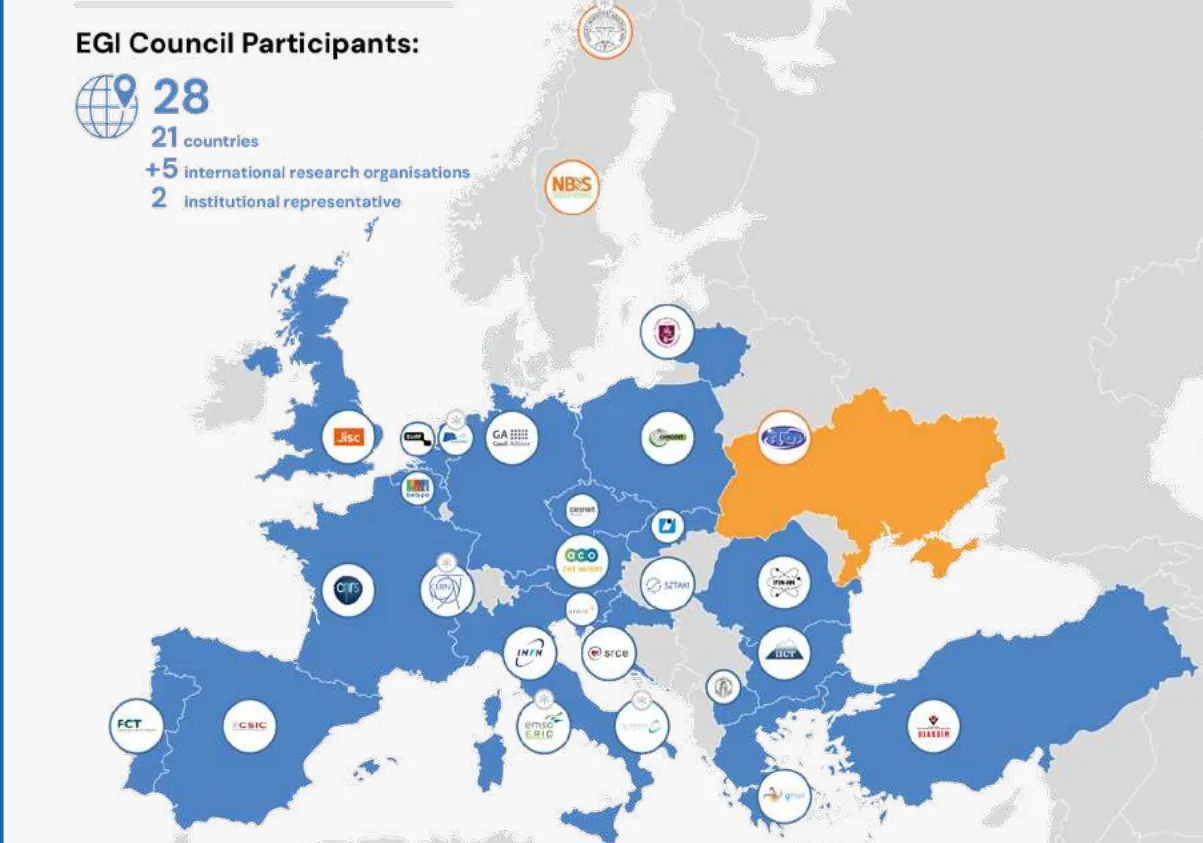
In 2025, EGI demonstrated substantial operational scale. The report highlights 163,000 supported researchers, more than 200 active research communities, over 210 federated service providers, 42 countries in the EGI infrastructure, users from more than 190 countries, and around 2,600 scientific publications per year supported through EGI-enabled workflows. It also reports more than 40 Research Infrastructures engaged across operations, projects and R&D collaborations, 19 new scientific communities, 9 platforms co-developed with Research Infrastructures, and two AI-enabled research environments. These figures show that EGI functions as a large-scale operational ecosystem in which computing, data, identity, user support and joint development are combined within a single federated model.
A central concept of the report is the move towards an AI-ready compute-data continuum. EGI positions itself as an environment in which researchers can access computing capacity, data, analytical tools and expertise regardless of the geographical location of the underlying resource. The report stresses that contemporary science increasingly requires not isolated services, but connected environments where cloud, HPC, HTC, data services, identity services and AI capabilities operate as parts of one workflow. This is especially important for data-intensive disciplines, where scientific outcomes depend not only on the availability of data or computing power, but also on reproducible workflows, portable computing environments, trusted access and interoperability across different actors in the federation.
The report structures EGI’s activities through three main value streams. The first, Power the Federation, covers platforms, policies, governance and coordination mechanisms needed for a multi-country federation. The second, Enable Scientific Computing, concerns access to AI-ready computing, data services and value-added capabilities for research communities. The third, Enable Sustained Innovation, focuses on collaborative R&D activities through which project results can become sustainable services or reusable digital solutions. This structure shows that EGI treats infrastructure not only as a technical system, but as a combination of resources, rules, service management, expertise and long-term partnerships.
Technical innovation is another major theme. In 2025, EGI continued to develop federation across cloud, HPC and HTC through a common layer of access and identity. The report mentions the production deployment of the EGI Artefact Registry for container images, expanded image synchronisation across FedCloud providers, Kubernetes federation via Cloud Container Compute, Dynamic DNS integration with Infrastructure Manager, enhanced Notebooks and Replay services with Check-in tokens, and early HPC integration through Kubernetes-to-supercomputer workflows. These developments are significant because containers, notebooks, orchestration and federated identity are becoming core instruments for reproducibility, workload portability and operational consistency in scientific computing.
The report gives particular attention to cooperation with European Research Infrastructures. In 2025, EGI strengthened its model of strategic partnerships through Service Level Agreements, Memoranda of Understanding, joint R&D activities and domain-specific platform development. Research Infrastructures are presented not merely as users of resources, but as co-designers of digital solutions. This changes the logic of infrastructure development: instead of building a universal set of services from the top down, EGI develops capabilities together with scientific communities that have concrete data, workflows, security requirements, access models, performance needs and reproducibility constraints.
Examples from different disciplines illustrate the breadth of EGI’s use. In physical sciences, the infrastructure supports large-scale simulations, data processing and distributed analysis. In Earth observation and environmental sciences, EGI enables access to large datasets, scalable processing and interoperable services. In biodiversity research, bioinformatics, planetary science, social sciences and cultural heritage, the report demonstrates the use of cloud resources, object storage, Kubernetes-based environments, Jupyter-based workflows, EGI DataHub and EGI Check-in. These examples are important because they show real scientific scenarios rather than abstract infrastructure: data processing, shared access, reproducible computation, secure identity management, and the integration of data and services into domain-specific environments.
The report also places EGI within the broader European policy context. It links EGI’s activities to Open Science, the European Research Area, the Digital Decade, Common European Data Spaces and AI in Science. In 2025, coordination between major European e-infrastructures was strengthened around EOSC strategy, governance and joint outreach, while approaches to supporting the EOSC Node model were further developed. This means that EGI sees its role not as an isolated infrastructure provider, but as part of a wider European research ecosystem in which federated resources, data, services and policies are expected to operate under aligned rules.
The strategic outlook of the report is connected to the EGI Federation Strategy 2026–2030. This strategy defines EGI’s ambition to become “Europe’s essential federated, AI-ready compute-data continuum for research communities.” It responds to several major trends: the growing need for trusted and resilient systems for Open Science; the transformation of artificial intelligence into a standard research tool; the demand for cross-domain infrastructure; the importance of digital sovereignty; and the shortage of specialists who can connect infrastructure expertise with domain-specific scientific problems. In this sense, EGI presents future research infrastructure as a combination of technologies, people, competencies, service management and access policies.
Overall, the 2025 EGI report demonstrates a mature model of next-generation federated digital infrastructure. Its core is not only computing capacity, but also trusted access, interoperability, shared governance, reproducible environments, domain platforms, AI-ready data services and sustainable partnerships with research communities. The main conclusion of the report is that modern research infrastructure should not be understood as a single service or a central pool of resources. It should be seen as a federated ecosystem capable of supporting the full data lifecycle: access, computing, analysis, reuse, artificial intelligence and long-term scientific collaboration.