MATSCI-NASU
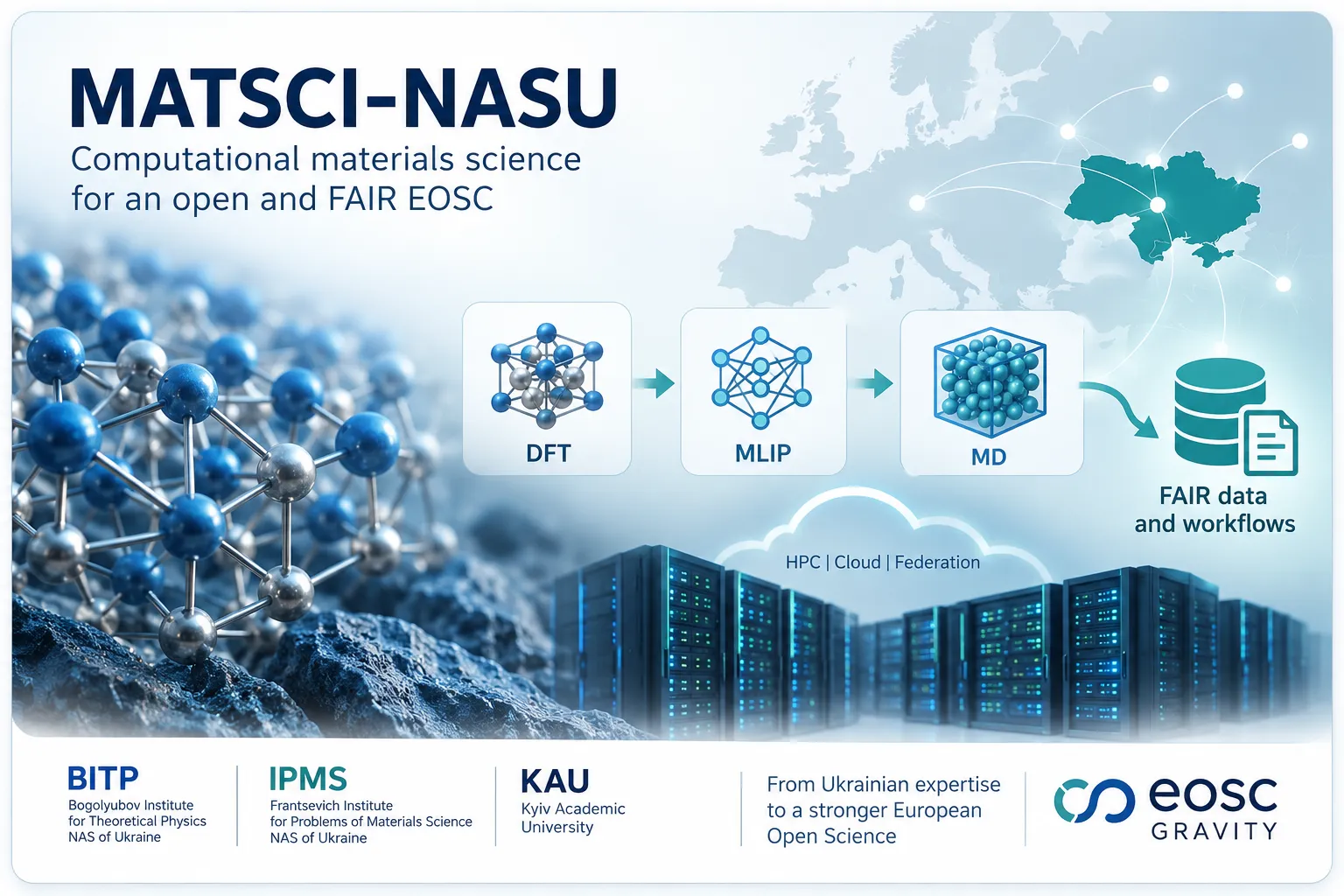
Concept of the MATSI-NASU project as a pilot scenario for establishing a thematic EOSC node for materials science at the National Academy of Sciences of Ukraine.
MATSCI-NASU is preparing a thematic EOSC Node for computational materials science, bringing together computing infrastructure, scientific workflows and FAIR data stewardship.
The project is led by the Bogolyubov Institute for Theoretical Physics of the National Academy of Sciences of Ukraine (BITP), together with the Frantsevich Institute for Problems of Materials Science (IPMS) and Kyiv Academic University (KAU).
MATSCI-NASU develops a model in which established computational materials-science workflows can be offered as authenticated, pre-configured services with computing resources behind them. The resulting data and workflow outputs are captured with provenance, curated and returned as citable FAIR research objects.
Project at a glance
Key facts about MATSCI-NASU and its role in preparing a thematic EOSC Node for computational materials science.
Computational materials science
Beginning with solid materials and the pilot DFT → MLIP → MD workflow.
EOSC GRAVITY Preparatory Grant
Preparing governance, technical readiness, services and community engagement for a future thematic Node.
BITP
Bogolyubov Institute for Theoretical Physics of the National Academy of Sciences of Ukraine.
BITP · IPMS · KAU
Infrastructure and operations, scientific workflows and domain curation, FAIR data stewardship and training.
DFT → MLIP → MD
A computational materials workflow being developed into an authenticated federated service with FAIR return.
EOSC Federation
Federated AAI, EOSC resource discovery, persistent identifiers, provenance and reusable FAIR research objects.
Why MATSCI-NASU
MATSCI-NASU addresses practical gaps that currently limit the reuse of computational materials-science workflows and the research data they produce.
Workflows are difficult to reuse
Many computational workflows can in practice be run only by the groups that built them because the software environment, configuration and operational knowledge are not packaged for reuse.
Computational outputs remain hard to reuse
Results often remain on the systems where they were produced, without sufficient metadata, persistent identifiers or preserved links between workflow stages, making them difficult to find, cite and reproduce.
A missing disciplinary and geographic contribution
Ukrainian computational materials science, its established workflows and the data produced by them are not yet represented as a dedicated contribution within the EOSC Federation.
Infrastructure, domain expertise and FAIR data stewardship
HPC, cloud, repository, authentication and operational infrastructure for delivering computational services.
Scientific workflow onboarding, materials-science expertise and domain validation of computational services and outputs.
Metadata profiles, FAIR packaging conventions, curation, documentation and training through the NASU FAIR Data Competence Center.
The differentiator is their integration. MATSCI-NASU combines computing infrastructure, domain workflow expertise and FAIR data stewardship so that established workflows can become reusable services and their outputs can return as provenance-complete FAIR research objects.
Value to researchers: use a validated workflow on their own material without having to assemble the complete software stack and computing environment, while receiving outputs prepared for documentation, citation and reuse.
How MATSCI-NASU works
MATSCI-NASU follows a compute-and-return model: researchers access pre-configured computational workflows and computing resources, while workflow outputs are captured, curated and returned as reusable FAIR research objects.
From computation to FAIR reuse
Federation or researcher-provided data can serve as workflow inputs. Computation is performed in an authenticated environment with access to HPC or cloud resources. Outputs and their relationships are captured with provenance, curated, deposited with persistent identifiers and prepared for discovery and reuse through the EOSC Federation.
Research data
Federation data or researcher-provided data serve as workflow inputs.
Authenticated access
Users access MATSCI-NASU services through the federated AAI layer.
Pre-configured workflow
An onboarded scientific workflow is provided as a prepared computational environment.
HPC & Cloud compute
BITP computing resources provide the capacity required to run the service.
Provenance capture
Workflow outputs and the links between computational stages are recorded as the workflow runs.
FAIR curation
Metadata, documentation, packaging and access conditions are checked before publication.
Deposit & PID
FAIR research objects are deposited in DataverseUA and assigned persistent identifiers.
Discovery & reuse
Provenance-complete research objects are prepared for discovery and reuse through the EOSC Federation.
The result: researchers gain access to a validated computational workflow and computing resources, while MATSCI-NASU returns documented, citable and reusable research outputs rather than leaving results isolated on the systems where they were produced.
Repositories and services
MATSCI-NASU combines production research infrastructure with new FAIR data and workflow services being prepared for integration with the EOSC Federation.
Open Data Repository NAS of Ukraine
Production repository for research data of the National Academy of Sciences of Ukraine. Within MATSCI-NASU it provides the repository pathway for FAIR research objects generated by Node services and participating communities.
Deposit, metadata exposure and publication of research objects for discovery and reuse.
BITP HPC Grid Cluster
Production HPC infrastructure operated by BITP and connected to the EGI grid infrastructure. It provides computing capacity for MATSCI-NASU scientific workflow services.
Federated access to high-performance computing resources for computational materials-science workflows.
BITP Cloud Cluster
OpenStack-based production cloud infrastructure operated by BITP and participating in the EGI Federated Cloud.
Cloud resources for authenticated users and deployment of MATSCI-NASU computational services.
FAIR Data and Workflow Service
A service framework for onboarding computational datasets and workflows, capturing their outputs and returning curated FAIR research objects to the repository and the Federation.
A repeatable route for workflow onboarding, metadata preparation, provenance capture, FAIR packaging, curation and repository deposit.
DFT → MLIP → MD Workflow Service
The first domain workflow developed as a MATSCI-NASU service. It combines DFT calculations, machine-learning interatomic potentials and molecular dynamics in a prepared computational environment with computing resources behind it.
An authenticated scientific workflow service with compute, provenance capture and curated return of FAIR data and workflow outputs.
Integrated service model. The value of MATSCI-NASU comes from connecting existing repository, HPC and cloud infrastructure with workflow execution, provenance capture and FAIR data stewardship. Together, these resources support the complete route from computation to a reusable research object.
Pilot use case
DFT → MLIP → MD
Computational materials science workflows as federated services, with curated return of FAIR workflows and data
The first MATSCI-NASU service implements a DFT → MLIP → MD workflow for solid materials. The service is being developed from an environment already used in production research and combines Quantum ESPRESSO, PyTorch with NequIP, and ASE.
The objective is to make the workflow usable beyond the group that originally assembled it. Researchers will be able to access a prepared computational environment, apply the workflow to their own material and obtain outputs that are documented, provenance-complete and suitable for FAIR publication.
Pilot workflow: DFT → MLIP → MD
The first MATSCI-NASU pilot service transforms a computational materials-science workflow into a reusable service, connecting simulation stages with provenance, FAIR curation and repository publication.
From atomistic calculation to reusable FAIR research object
The MATSCI-NASU pilot workflow begins with DFT calculations, continues with the training and validation of machine-learning interatomic potentials, and proceeds to molecular-dynamics simulation. The outputs are then prepared for FAIR publication with metadata, provenance and persistent identifiers.
DFT
Reference electronic-structure calculations produce the training data and atomistic descriptors needed for the workflow.
MLIP
Machine-learning interatomic potentials are trained, validated and prepared for further atomistic simulation.
MD
Molecular-dynamics calculations generate simulated material behaviour and derived properties for analysis.
FAIR return
Workflow outputs are linked with provenance, described with metadata, packaged for reuse and deposited as FAIR research objects.
DFT: Quantum ESPRESSO
MLIP: PyTorch with NequIP
MD: ASE
Metadata profile, provenance links, README, manifest, model card, repository deposit and persistent identifiers.
What the pilot delivers
Pre-configured computational environment. Software stack and workflow configuration prepared for reuse.
Authenticated access to compute. HPC and cloud resources provided through the Node access layer.
Provenance capture. Links between stages and outputs recorded while the workflow runs.
FAIR deposit and publication. Research objects deposited in DataverseUA with persistent identifiers.
Reusable onboarding route. The same route can be applied to additional computational workflows.
Technical readiness & EOSC integration
MATSCI-NASU builds on production computing and repository infrastructure and extends it with the authentication, service delivery, provenance, discovery and operational components required for federated use.
Connecting existing infrastructure to the EOSC Federation
BITP HPC and cloud resources and the NASU Open Data Repository are already in production. MATSCI-NASU extends this base with federated authentication, EOSC resource registration, managed workflow environments, provenance capture and operational monitoring and support.
Authentication & authorisation
Access to MATSCI-NASU services is being prepared through federated authentication and authorisation mechanisms compatible with EOSC and EGI infrastructure.
eduGAIN · MyAccessID · EGI Check-in · SATOSA · Keycloak · SAML 2.0 · OIDC/OAuth 2.0
Resource discovery & cataloguing
MATSCI-NASU resources and services are planned for registration in the EOSC resource environment so that they can be discovered by users across the Federation.
EOSC Resource Catalogue · Resource Hub Node Registry · Provider interface
Workflow environment
Existing scientific software environments are being packaged and deployed so that computational workflows can operate as managed services on MATSCI-NASU HPC and cloud resources.
Apptainer · NVIDIA CUDA · OnDemand · OpenStack · Kubernetes
Provenance, metadata & persistent identification
Workflow outputs and their relationships are prepared for machine-actionable reuse through provenance capture, repository metadata, persistent identifiers and metadata exposure through established interfaces.
AiiDA · NOMAD · DataCite · OAI-PMH · OpenAIRE
Monitoring, accounting & user support
Existing EGI monitoring and accounting mechanisms will be reviewed for MATSCI-NASU service operation, together with integration of a helpdesk route for user support.
ARGO monitoring · EGI accounting · Zammad-based helpdesk
BITP HPC Grid Cluster connected to the EGI grid infrastructure.
BITP OpenStack Cloud Cluster participating in the EGI Federated Cloud.
DataverseUA in production with metadata exposure through established repository interfaces.
Project outputs
The MATSCI-NASU build-up programme is organised around five groups of deliverables covering governance, Federation integration, Node services, FAIR data stewardship, and community onboarding and training.
Establishing the operational and policy framework
Connecting MATSCI-NASU to the EOSC Federation
Building the operational workflow services
Making computational outputs reusable
Installed as DataverseUA metadata blocks and tested on real research objects.
Per-stage checklists, README, manifest and model card, including curation sign-off and deputy support.
Opening the Node to users and new workflows
Two application pathways, readiness review and published evaluation criteria.
Documentation, worked examples, FAIR clinics, webinars and EOSC Academy materials delivered through the NASU FAIR Data Competence Center.
Pilot reference set, one external material and a second workflow type carried through to deposit.
Readiness self-assessment, engagement indicators, onboarding lessons and roadmap for the operational phase.
From readiness to operation. The deliverables move MATSCI-NASU from governance and technical preparation through Federation integration and service deployment to external workflow onboarding, FAIR research-object publication and an operational-phase roadmap.
Community and onboarding
MATSCI-NASU treats community engagement as an operational part of the Node service model. The project supports researchers, research groups and service providers in preparing datasets, workflows and digital services for federated use.
From consultation to onboarding
The MATSCI-NASU website serves as the main public entry point for the Node scope, participating organisations, use cases, available and planned services, onboarding options, training activities, application pathways and contact points.
Materials-science researchers
Computational and experimental materials-science groups from NASU institutes and Ukrainian universities.
Data stewards
Specialists supporting FAIR data preparation, metadata, curation and repository publication.
Research support staff
Repository managers, research-support staff and young researchers developing FAIR data practices.
EOSC partners
Partners interested in reusable materials-science datasets, documented workflows, trained interatomic potentials and simulated properties.
For researchers and research groups
This pathway is intended for researchers seeking support in preparing datasets or documenting computational workflows through MATSCI-NASU services.
- fit to the MATSCI-NASU scope;
- RDM and FAIR readiness;
- metadata availability;
- repository readiness;
- potential for FAIR dataset or workflow publication.
For service providers
Institutes, laboratories and scientific groups may propose a materials-science workflow or digital service for readiness review and possible inclusion in the Node portfolio.
- service relevance;
- identified owner and support contact;
- target users and access conditions;
- maturity level and documentation;
- metadata readiness and support capacity.
Website updates, targeted communication with pilot groups, practical webinars, FAIR data and workflow clinics, onboarding consultations and reusable guidance materials.
Expressions of interest, applications reviewed, consultations, readiness checks, workflows or datasets piloted, services assessed, FAIR research objects deposited, training participation, reusable templates and user feedback.
Roadmap
The MATSCI-NASU build-up roadmap moves from governance and integration design to federated operation, external workflow onboarding and readiness for the operational phase.
From project launch to operational readiness
Thirteen milestones structure the MATSCI-NASU build-up phase. They cover governance, EOSC integration, technical deployment, FAIR data and workflow services, external onboarding and the transition towards an operational thematic Node.
Governance and integration design
Authorisation, access and Node identity
Federation visibility and FAIR baseline
End-to-end service operation
External onboarding and operational roadmap
Consortium
MATSCI-NASU brings together complementary capabilities in research infrastructure, computational materials science and FAIR data stewardship.
BITP
Coordinates the project and provides the computing, authentication, repository and operational infrastructure required for MATSCI-NASU services and Federation integration.
IPMS
Implements and supports computational materials-science workflows as federated services and provides workflow onboarding and domain curation.
KAU
Supports metadata, FAIR packaging, provenance, curation, documentation and training, including activities delivered through the NASU FAIR Data Competence Center.
MATSCI-NASU Project Charter
The Project Charter defines the scope, value proposition, resources and services, use cases, technical integration, external dependencies and risks, project outputs, community-engagement model, milestones and governance framework for MATSCI-NASU.
Designing the Governance, Core Readiness, and Pilot Use Case for the NASU Materials Science Thematic Node
MATSCI-NASU
EOSCGRAVITY-PREP-2026-023-MATSCI-NASU
101188045
BITP
BITP · IPMS · KAU
This project has been funded within the Cascading Grants under the EOSC Gravity Project, which has received funding from the European Union's Horizon Europe programme under Grant Agreement No. 101188045.
The views and opinions expressed are those of the author(s) only and do not necessarily reflect those of the European Union, the granting authority or the EOSC Gravity partners.